
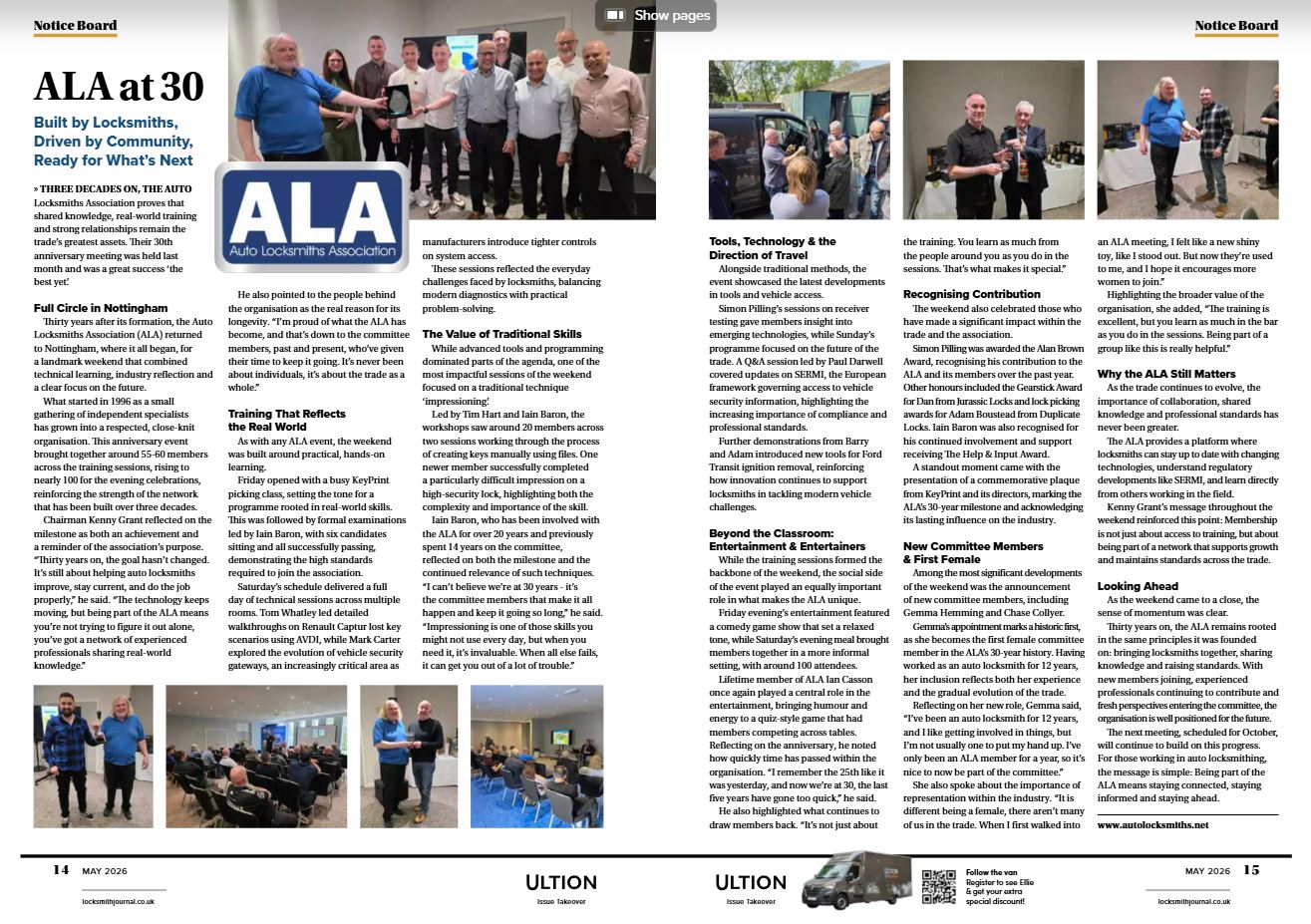
As the Auto Locksmiths Association (ALA) prepares to celebrate its 30th anniversary at its upcoming meet-up on 25-26 April in Nottingham, it marks far more than a milestone; it highlights a journey that has shaped, protected, and future-proofed the auto locksmithing trade.
From its origins as a small gathering of isolated specialists to a globally respected organisation, the ALA has played a pivotal role in uniting the trade, driving innovation, and ensuring locksmiths remain relevant in an increasingly complex automotive landscape. The Locksmith Journal is proud to tell the tale of its journey.
A Trade Without a Voice
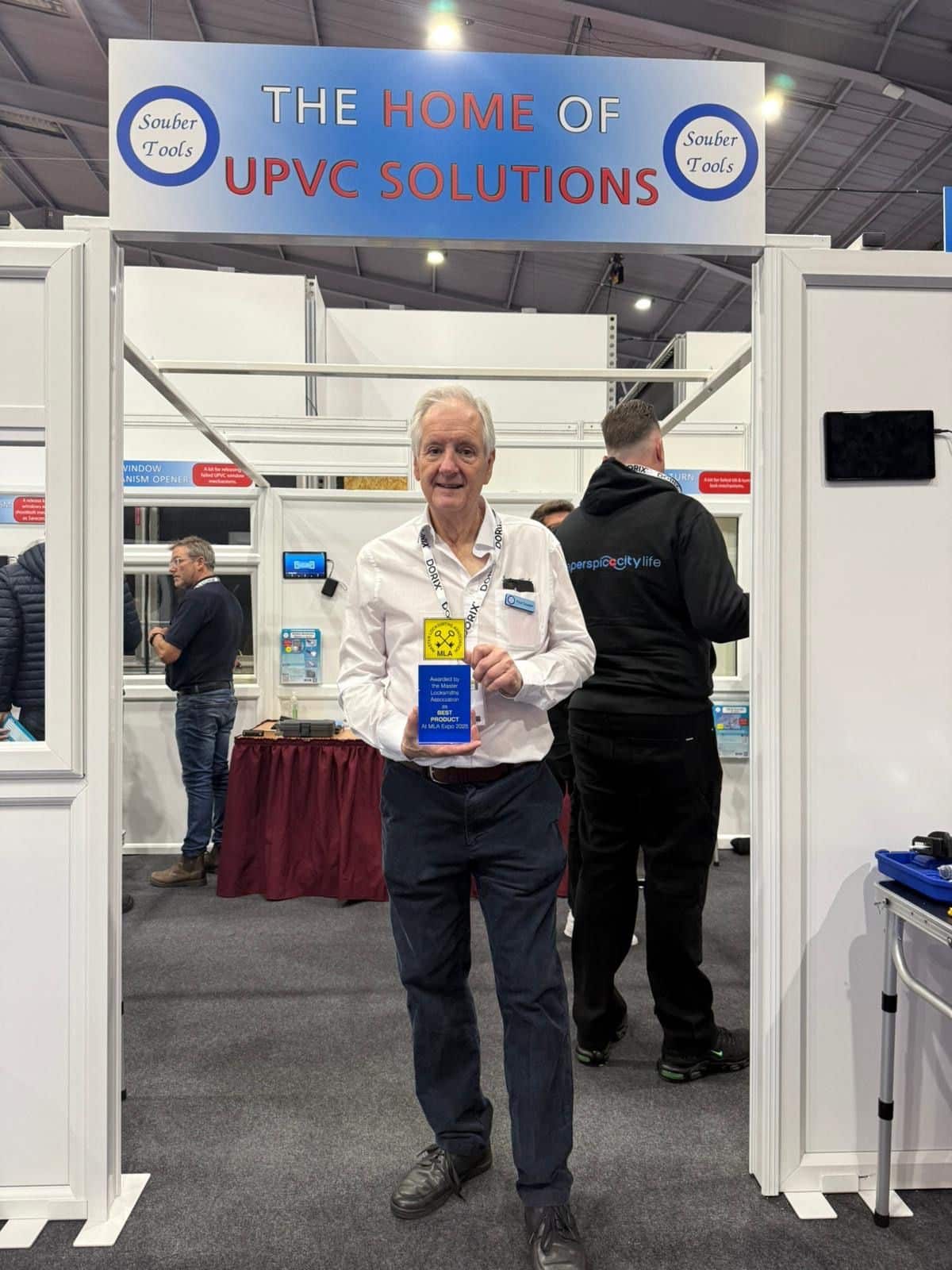
Paul Souber, the founder of the ALA, has spent over 51 years in the lock industry. By the late 1980s, while manufacturing locksmith tools and supplying car lock parts, he identified a major issue: Auto locksmiths existed, but only as individuals. Paul told us:
“There was no organisation, no training, no association anywhere in the world. Auto locksmiths were fragmented and isolated.”
Traditional bodies like the MLA did not cater for automotive specialists, despite the growing demand and increasing technical complexity of vehicle security. Frustrated but determined, Paul set out to bring the trade together.
The First Gathering – Nottingham, 1996
In early 1996, Paul organised a weekend meet-up at the Nottingham Gateway Hotel, inviting over 50 locksmiths who had identified themselves as doing automotive work.
The event featured, technical lectures from Steve Gallagher (Mercedes locks), Gary Watts (impressioning), and Terry Watts, networking, discussion, and shared learning. Attendees including John Bodley and other early pioneers.
The response was overwhelmingly positive. “At the end of the weekend, I asked – shall we do it again?” Paul recalls. That single question laid the foundation for what would become the ALA.
The Formation of the ALA
Although there were no immediate volunteers to form a committee, a core group soon emerged, including: Terry Watts, Gerry Bryant, Richard Blackburn, Peter Southern, (later Mark Whapples and later Rob Hassall (automotive electrician and long-serving chairman).
These individuals, alongside Paul, helped establish the structure and direction of the ALA, holding regular meetings and building a network that was run by locksmiths, for locksmiths.
The Turning Point: Transponders & AD100
As vehicle security evolved, the introduction of transponder systems created a major challenge. Manufacturers offered no training or support, leaving locksmiths locked out of modern vehicles. The breakthrough came when two former Lucas engineers: Greg Chambers and Parmjit Singh, were introduced to the ALA through a chance meeting with Duncan of Hickley Valtone at Gerry Bryant’s shop.
At an ALA meeting, the newly formed company Advanced Diagnostics Ltd proposed developing a diagnostic machine that could programme vehicle keys. When asked for commitment, 37 out of approximately 50 members raised their hands. That machine became the AD100.
It was the first tool of its kind available to independent auto locksmiths, transforming the trade and enabling programming capabilities previously restricted to dealerships only.
“If we didn’t have the ALA, we may not have had Advanced Diagnostics,” Paul explains. “It all felt coincidental at the time, but was an integral to the future of the auto locksmithing trade.”
Built by the Trade, for the Trade
From the beginning, the ALA has been a professional body exclusively for working auto locksmiths, not a training school, but a network of qualified individuals committed to raising standards.
Over time, key figures such as Nicky Rutter and Ron Wakely developed the entry exams and practical assessments that are still used today, ensuring that membership reflects real competence.
The organisation has grown to around 100 vetted members, all active in the trade, with strict requirements including DBS checks, practical assessment, and ongoing participation.
The organisation has grown to around 100 vetted members, all active in the trade, with strict requirements including DBS checks, practical assessment, and ongoing participation.
Growth, New Members & International Reach
While rooted in the UK, the ALA has steadily expanded its reach.
In recent years, new members have joined from across Europe, including Portugal, Iceland, Denmark, and Ireland, with connections extending to Italy and the USA. These international relationships, often built through shared training and collaboration, reflect the growing global relevance of the association.
Events such as the world’s first auto-only locksmith convention in Manchester, which attracted over 400 attendees from 28 countries, demonstrate the ALA’s influence beyond the UK.
Key contributors to that success included John Bodley and Tim Hart, alongside a dedicated team of members who invested their own time and resources to deliver the event.


Legislation, Responsibility & the Modern Locksmith
As vehicle security becomes more sophisticated, so too does the regulatory environment. One of the most significant developments affecting auto locksmiths across Europe is the introduction of SERMI (Secure Repair and Maintenance Information).
SERMI is a Europe-wide scheme designed to ensure that only independent operators who have been properly vetted and authorised can access security-related repair and maintenance information for vehicles. This includes sensitive data and functions such as key programming, immobiliser systems, and other anti-theft components.
Under SERMI, both businesses and individual technicians must undergo an approval process carried out by accredited Conformity Assessment Bodies. This process includes:
- Verification of business legitimacy
- Criminal record checks
- Validation of professional activity within the automotive sector
Once approved, locksmiths and other independent operators are granted access to manufacturers’ security-related information via a standardised and controlled system.
For auto locksmiths, SERMI represents a major shift:
- It formalises access to critical vehicle data
- It introduces consistent rules across participating European countries
- It reinforces the importance of operating transparently and professionally
While SERMI creates new administrative requirements, it also helps protect the trade by ensuring that access to high-security vehicle systems is restricted to vetted professionals only.
In an industry where trust, legality, and responsibility are paramount, schemes like SERMI underline the direction of travel: tighter regulation, greater accountability, and higher professional standards across the board.
Chairman’s Perspective: Continuing the Momentum
Current chairman Kenny Grant emphasises that the ALA’s strength lies in its ability to keep members moving forward as the trade evolves.
“Thirty years on, the goal hasn’t changed, it’s still about helping auto locksmiths improve, stay current, and do the job properly,” Kenny says. “The technology keeps moving, whether that’s diagnostics, EEPROM work, or tools like SEMIE. Being part of the ALA means you’re not trying to figure it out alone, you’ve got a network of experienced professionals sharing real-world knowledge.”
Kenny also highlights the importance of the people behind the organisation:
“I’m proud of what the ALA has become, and that’s down to the committee members, past and present, who’ve given their time to keep it going. It’s never been about individuals; it’s about the collective effort to keep standards high and the trade moving forward.”
Still Run by Working Locksmiths
One of the ALA’s defining strengths is that it remains run by active professionals.
The current committee continues the association’s focus on training and development, supported by experienced members who contribute knowledge from real-world jobs.
“The goal’s always been to keep it professional,” as former chairman Andy Morgan explains. “If someone’s got the ALA symbol on their website, they should know what they’re doing.”
Looking Back & Forward
Paul Souber stepped back from the committee after five to six years, confident that the organisation was on solid foundations. Reflecting on 30 years of the ALA, he remains proud, but characteristically modest:
“I’m very proud, but I can’t take any credit. It happened because the right people came together at the right time and addressed the problem. If we hadn’t done it, what would have happened to the profession?”
Full Circle: Back to Nottingham
As members (old and new) gather once again in April, they all reunite to celebrate the amazing 30-year milestone of ALA. From a single flyer and a hotel booking to a thriving international organisation, the ALA’s journey is a testament to what can be achieved when a trade unites with purpose.
Thirty years on, its mission remains unchanged: It’s an association run by members, for members: keeping auto locksmithing professional, connected, and ready for the future.
See this story featured in The Locksmith Journal:
https://viewer.joomag.com/the-locksmith-journal-119-april-2026/0016445001777372140/p50